Real Counselors. Honest Answers.
More Answers From Masters in Counseling Graduates
4 Steps to Getting a Career in Counseling

Step 1
Earn a Degree
Earn an accredited Master’s Degree in Counseling.

Step 2
State Licensure
Sit for your state’s Counseling Licensure Exam.
Step 3
Board Certification
Consider an optional National Certified Counselor or other certification.

Step 4
Seek employment
Salary range, $34,730 to $81,960 (BLS 2020).
Best Online Masters in Counseling Programs
Want More Options? See Our Directory of Masters in Counseling Programs
What Our Experts Say About Online Masters of Counseling Programs
I chose a master’s program that was online because of my work schedule. Also, online programs, not only do they give you flexibility, they also give you more [counseling program] choices. That really is what pushed me to looking into an online program. And I was able to pace myself. And I think that was key.

There are a lot of programs out there with online master’s in counseling. The plus side of doing that is that you can work in whatever job you have and take classes on the side and be able to juggle both of those rather than going to a lot of in-person programs. The drawback, though, is that there’s a lot of sharing and talking and group dynamics that you can gain from in-person classes that you may not get in an online setting.

To get admitted, most masters programs are going to require a successful completion of a bachelor’s degree. Usually any major, doesn’t have to be a specific major with a minimum of 2.5 or 2.75 GPA, and the completion of either the GRE or the MAT. And usually a personal statement. And then it’s not a requirement, but a lot of counseling programs are looking for on your resume any previous experience that you’ve had working with people in general.

Frequently Asked Questions
Education
What is a Masters In Counseling Degree?
What is a Masters In Counseling Degree?
A Master’s in Counseling degree is a graduate-level degree program that typically requires 60-credit hours of coursework and supervised clinical experience. This degree equips students with the skills and knowledge necessary to provide counseling services to individuals, couples, families, and groups. The curriculum covers topics such as counseling theories and techniques, ethics, assessment, and diagnosis. Masters of counseling graduates can pursue careers as licensed professional counselors, school counselors, marriage and family therapists, mental health counselors, and substance abuse counselors, among others. They often work in settings such as mental health clinics, private practice, hospitals, schools, and community agencies.
How Important is School Accreditation In Picking A Counseling Program?
Selecting a college or university that is accredited, is an important part of the counseling program selection process. That is true for four primary reasons:
- Educational Quality: Accredited colleges are reviewed by an independent accrediting agency to make sure they meet certain educational standards, including the quality of instruction, curriculum and faculty, thus better ensuring you’ll receive a quality masters in counseling education.
- Professional Credibility: Employers, particularly in institutional settings like hospitals and schools, highly value accreditation in weighing the quality of the school that a job applicant has attended. Accredited masters of counseling programs provide a level of professional credibility for those employers that cannot be discounted.
- State Licensing: In many states, you cannot be licensed as a counselor unless the masters program you attended was accredited. In others, the requirements for a licensed counselor are higher if the college you attended was not accredited.
- Board Certification: Many board certification bodies only permit applicants for board certification who have attended accredited masters in counseling programs.
The Different Types Of Masters In Counseling Programs
There are a few categories of degree options when it comes to masters degrees in counseling. Which one you choose depends largely on your interests and what you plan to do with your degree after you graduate.
The following are the most common categories of counseling degrees and where they can lead:
- Master of Arts (MA) in Counseling: MA programs often focus on theoretical understanding and include seminar-style classes and advanced level reading and writing.
- Master of Science (MS) in Counseling: MS programs focus more on the technical and hands-on aspects of the counseling practice.
- Master of Education (MEd) in Counseling: MEd programs are typically designed to develop skills relevant to a wide range of careers in social service and mental health agencies, as well as preparing graduates to become certified as school counselors.
- Masters of Counseling Psychology: Counseling psychology programs prepare graduates for research, teaching and/or counseling in a variety of settings with an emphasis on causes, diagnosis, and treatment strategies.
Of note, when doing your research, it is important to understand that each of these different degrees has it’s own unique curriculum and program structure depending on where it is offered. So look at each college or university’s program closely before enrolling.
Can I Get A Masters Degree In Counseling Online?
Yes. Almost every type of masters in counseling degree is offered in a fully online and hybrid format. Due to their potential for increased flexibility and cost savings, online masters in counseling programs are increasingly popular.
Of note, whether you’re considering enrolling at traditional brick-and-mortar institution or at an online university, you should look at every degree program with a critical eye. It is crucial to know if the program is accredited by a National Accreditation Agency, if it properly prepares students for licensure and certification exams, and if it offers a specialization/focus aligns with your career goals.
Pros & Cons of Online vs. Campus Programs
Getting a Master’s degree in Counseling online has both advantages and disadvantages, and so you need to know both before making a decision.
Pros to an Online Masters in Counseling Program:
One of the primary benefits of getting a master’s degree in counseling online is the flexibility it offers. Students can learn at their own pace, from anywhere and at any time, allowing them to balance their studies with other commitments like family or career. Additionally, online programs can be less expensive than traditional in-person programs, as there are no transportation or housing costs associated with attending classes on campus.
Cons to an Online Masters Degree in Counseling Program:
There are some drawbacks to getting a Master’s degree in Counseling online. Although online learning platforms have improved dramatically, online counseling programs can still lack the personal touch and interaction that comes with a traditional classroom setting, which can make it difficult for some students to feel connected to their classmates and instructors. Additionally, online programs may not offer the same level of hands-on experience that in-person programs can provide, such as in-person counseling sessions, which are essential for gaining practical experience in the field.
Another potential disadvantage of online programs is that they may not be accredited by the Council for Accreditation of Counseling and Related Educational Programs (CACREP), which is a requirement for licensure in some states. It’s vital to research online masters of counseling programs carefully, to ensure they’re fully accredited before enrolling.
Career
Step-By-Step: How To Become A Counselor
How To Become A Counselor
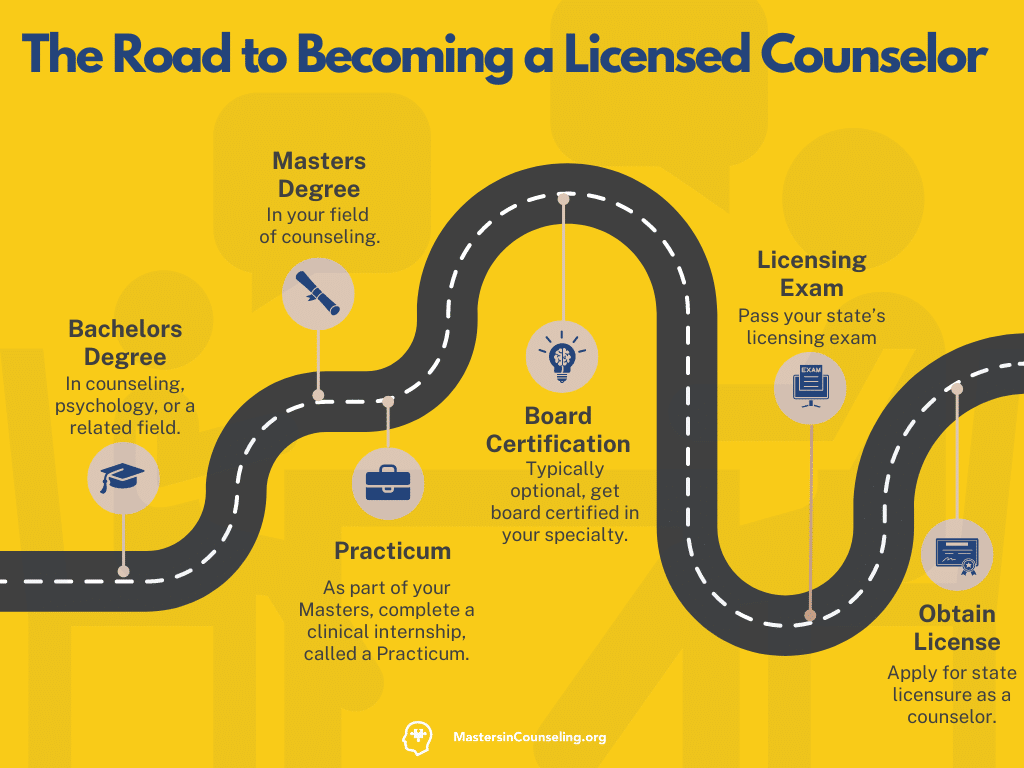
Below is a step by step guide on how to become a licensed counselor:
- Get a Bachelor’s degree: The first step in becoming a licensed counselor, (whether school, mental health, clinical, family or other) is to obtain a Bachelor’s degree in counseling, psychology, or a related field. This degree takes, on average, four years to complete.
- Obtain a Master’s degree in Counseling: After completing your Bachelor’s degree, the next step is to obtain a Master’s Degree in Counseling. This degree typically takes an additional two years of coursework (shorter for online programs) and includes supervised clinical experience.
- Complete a practicum and internship: As part of the Master’s program, you will need to complete a practicum and internship in a school setting under the supervision of a licensed school counselor. This experience allows you to apply the skills and knowledge you’ve learned in a real-world setting.
- Pass the licensing exam: Once you have completed your Master’s degree and clinical experience, you will need to pass your state’s licensing exam. This exam tests your knowledge of counseling theories, ethics, and legal issues.
- Obtain state licensure: After passing the licensing exam, you can apply for state licensure as a school counselor. Each state has its own licensing requirements, so it’s important to research the specific requirements in your state. Once licensed, you can begin working as a counselor.
Note: You can also choose to pursue a board certification in your counseling speciality (e.g. school, family, clinical, mental health, geriatric, etc.). These board certifications are typically optional, however, in some states being board certified will exempt you from having to complete a licensing exam, and in most situations improves your employability and potentially your salary.
What Are The Certification And Licensure Requirements For Counselors?
Licensure requirements for counselors depend largely on your career focus, as well as the location in which you’d like to practice. Licensing requirements for counselors vary by state, and each state requires applicants to earn an accredited degree, complete a specific number of post-graduate supervised hours, and pass an exam to be fully licensed. If you wish to practice in specialized field such as substance abuse or family therapy, you might need additional certification or a license.
To help you better understand how licensing and certification works, we’ve broken down both state and national requirements for counselors who wish to practice in the US: The following table offers a useful overview of licensure rules and certification requirements:
| National Certification | State Licensure |
|---|---|
| What is national certification? National certification is a voluntary process entirely separate from state licensure. It is not a license to practice; however, holding a national certification can assist counselors in obtaining a state license. | What is state licensure? State licensure is mandatory to practice counseling independently. These standards are set by regulatory boards in each state. |
| Name of national credential: National Board for Certified Counselors issues the National Certified Counselor (NCC) in addition to three specialty certifications in addictions, clinical mental health and school counseling. | Name of state credential: Licensure differs from state to state; however the most common titles are: Licensed Professional Counselor (LPC), Licensed Mental Health Counselor (LMHC), Licensed Clinical Professional Counselor (LCPC), Licensed Professional Clinical Counselor (LPCC). |
| National certification examinations: Students must pass the National Counselor Examination for Licensure and Certification (NCE). | National state examinations: State counselor licensure boards contract with NBCC to use one or both of the following exams: NCE and/or NCMHCE. |
| National certification requirements: Must complete a master’s degree in counseling or a related field from a regionally accredited institution.Must complete 3,000 hours of counseling experience as well as 100 hours of supervision over a two year time period after graduation.For graduate students who have completed CACREP accredited tracks, the post-master’s experience and supervision requirements are waived.Receive a passing score on the NCE. | State certification requirements: Must complete a master’s degree in counseling or related field of study from a regionally and/or nationally accredited institution.Must have counseling experience and supervision.Receive a passing score on the NCE exam and/or NCMHCE. Note: Some states require a passing score on mental health laws exam of that state.*Licensure varies by state; however, all states do require that students have a combination of the following: |
What Are My Career Options In Counseling?
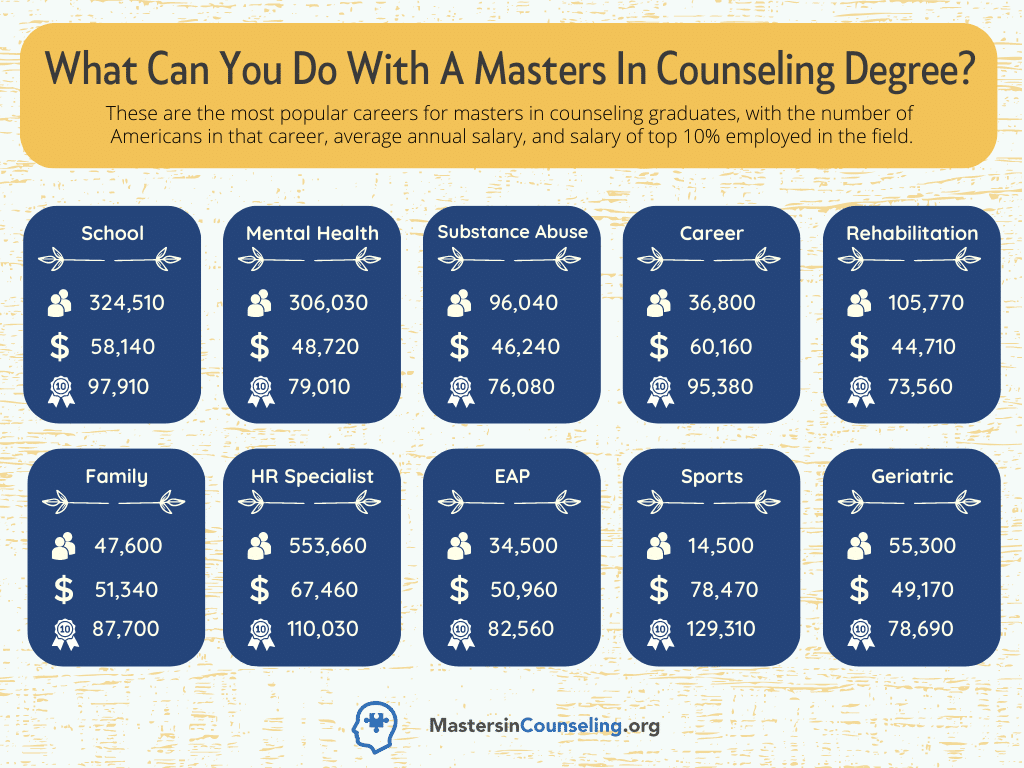
There are many different educational and professional paths you can take to have a fulfilling career in the counseling field. The table below lists the most common careers, as well as degree programs that are relevant to those careers. Counseling is a diverse field, encompassing several specialties. If you’re unsure of what kind of degree you should get, our guide will help you better understand your options.
| Type of Counselor | Relevant Degree Programs |
|---|---|
| Addiction and Substance Abuse Counselor: Substance abuse and addiction counselors provide treatment and support to help clients recover from addiction or modify problem behaviors. | MS in Addiction CounselingMS in Addiction PsychologyMS in Alcohol and Drug Counseling |
| Career Counselor: Career counselors help clients determine and plan for possible career paths by assessing their education, skills, interests, and personality. | MA in Psychology – Career Counseling & Management |
| Clinical Mental Health Counselor: Clinical mental health counselors help clients deal with a spectrum of mental and emotional disorders, as well as to promote mental health and wellness. | MS in Clinical CounselingMS in Mental Health Counseling |
| Geriatric Counselor: Geriatric counselors help individual and families deal with the aging process, such as issues related to retirement and loss. | MS in Gerontology |
| Marriage, Couple, and Family Counselor: Marriage, couple, and family counselors assist clients across of variety of mental and emotional disorders and relationship issues. | MS in Marriage, Couple and Family CounselingMA in Marriage and Family Therapy |
| Rehabilitation Counselor: Rehabilitation counselors help client with disabilities live independent, productive lives through unique treatment plans and therapy options. | MS Rehabilitation Counseling |
| School Counselor: School counselors are trained to promote the academic, career, and personal/social development of all K-12 students within the school setting. | MEd: School CounselingMS in School Psychology |
| Spirituality and Religious Counselor: Spirituality and religious counselors are devoted to helping clients draw on their spiritual values to deal with mental and emotional disorders. | MA in Pastoral Counseling |
| Trauma and Crisis Counselor: Trauma and crisis counselors help clients deal with the emotional impact of tragic events through a variety of processes including group and individual counseling. | MS in Mental Health Counseling – Trauma and Crisis Counseling |
Most Popular Careers For Counselors
There are literally dozens of counseling sub-specialties, but the majority of counselors work in one of the 15 or so most common counseling related fields. Here are the most common types of counselors in the United States ranked in order of the number of people employed in each field (BLS 2021):
- Social and Human Service Assistants – 414,660
- Child, Family, and School Social Workers – 311,820
- Mental Health Counselors and Marriage and Family Therapists – 307,460
- Educational, Guidance, School, and Vocational Counselors – 324,820
- Healthcare Social Workers – 195,790
- Mental Health and Substance Abuse Social Workers – 133,920
- Substance Abuse, Behavioral Disorder, and Mental Health Counselors – 120,860
- Probation Officers and Correctional Treatment Specialists – 91,090
- Rehabilitation Counselors – 86,330
- Substance Abuse and Behavioral Disorder Counselors – 73,270
- Health Educators and Community Health Workers – 66,700
- Social Workers, All Other – 40,810
- Counselors, All Other – 28,750
- Rehabilitation Counselors, Residential – 28,260
- Marriage and Family Therapists – 25,780
Of note, these are the fields that this grouping of counselors works in, the specific job title of an individual counselor might work in, will vary by state and employer.
Explore More

Career
Learn about counseling careers. From detailed descriptions of the most common careers for people with a masters in counseling, to certification requirements, learn all about a career in counseling.

Schools
Search our database of campus and online masters in counseling programs, request information about tuition, transfer credits and admissions from colleges that interest you, and learn what to consider when selecting schools.
Degrees
Learn what masters in counseling degrees best prepare you for which careers, the average tuition for a masters of counseling program, how fast you can get a masters degree in counseling and more.

Salary
Which counseling jobs pay the most and the least? How much more will you earn with a masters degree? Which states pay more, and how much does seniority impact your salary? Learn everything about counseling salary and wages.
Resources & Gallery
Learn More About Counseling Careers, Salary, and Degree Options By Visiting These Resources, and use our royalty free images of licensed counselors at work:
Education Resources
- Guide to Masters In Counseling Salaries
- Masters in Counseling Average Salary Analysis
- Guide To Masters In Counseling Scholarships And Grants
- Counseling Scholarships Worth Applying To
- Master Of Arts (MA) vs Master Of Science (MS) In Counseling
- Guide to Specializations in Counseling
- 4 Qualities of Every Successful Counselor
- Top Counseling Resources on The Web
- Essay: Why I Became A Counselor
Career Resources
- 100 Marriage and Family Therapy Resources
- Top Grief and Bereavement Resources on the Web
- Top Resources For Treating Bipolar and Depression
- Top eBooks On Depression
- Best Social Media Accounts For Counselors
- Counseling: How To Build Rapport With Clients
- Counseling: The Skill of Confrontation
- Counseling: The Skill of Self Disclosure
- Counseling: The Limits of Self Disclosure
- Counseling: Treating Narcissists in Couples Therapy